
Sunday, December 2, 2012
On mastery- more questions than answers...

Interlude- Drawnwork and Needlelace

I began by taking a piece of 3.5 ounce linen (approx. 80 threads per square inch) and remove 6 threads together. This may have been slightly more than I wanted, but I wanted it to be visible. I did a hem stitch to create a half-inch hem, and then went back and worked the drawn threads in both directions, creating, in theory, little boxes. Somehow, I got a torque in the material, so my lines slant- this may be a result of tension, hemming, or of removing too many threads. I should experiment in the future. I then decided to add a simple needlelace border, using 40/2 linen thread. Ideally, I would like to use 60/2, or perhaps 90/2, but I couldn't find those in my stash. the 120/2 was simply too lightweight too work. Overall, I'm happy with how my border came out, but it is a little "thick", probably due to the thread weight. The border was worked by making bars and covering with a buttonhole stitch.

Sunday, October 7, 2012
Blackwork Shift- Progress Shot!

It moves much faster than the polychrome embroidery, averaging about 40 minutes or so a motif. I'm still struggling with stem vs. outline stitch, and sometimes the stitch just looks "rope-y" no matter what I do, but that is in keeping with extant pieces, so the overall effect is still Elizabethan, at least to my eyes.
I rather enjoy how each little critter has their own personality.
Tuesday, September 4, 2012
Thinking about Thinking

It occurred to me that this also applied to the construction of deep knowledge in the SCA, particularly in applied Arts and Sciences. Let's use embroidery as a "for instance". When we begin looking at embroidery, we may begin by learning about the extant pieces. We can name them, locate them, and maybe find new ones. We are at the stage of "knowledge". We may then begin examining them more closely- maybe we identify the stitches being used, and maybe we figure out how the object was made. We may share this knowledge with others, demonstrating our "comprehension" of the subject. When we actually make a replica of an object, we've moved up to "application" of our comprehension. We don't just own the information, we've used the knowledge to construct something similar. Now this is where it gets tricky. What, exactly, is the difference between "application" and "creation/synthesis"? Well, it really depends on the next step, "analysis". Without a thorough analysis of the subject as a whole, one cannot truly synthesize their knowledge. Without an understanding of time and place, motifs, themes, and styles, one is left only applying their knowledge, instead of synthesizing it into a new creation.
At the top of the pyramid is synthesis and evaluation. These two really do go hand in hand. Without a critical eye (and I mean constructively critical) one cannot truly create a period artifact. One needs to evaluate what is (and is not!) there in the object before one can make informed choices about the object one is about to create.
So, in slightly simpler terms, using embroidery as a metaphor:
Knowledge: There is a polychrome coif in the Met, acquistion number 64.101.1258.
Comprehension: It's worked in detached buttonhole and plaited braid stitches.Motifs are birds, butterflies, roses, lillies, cornflowers.
Application: Experimenting shows that outlining the flowers first in stem stitch makes it easier to do the detached buttonhole evenly. Starting with a row of running stitches stops me from making too many buttonhole stitches.
Analysis: These flowers are all found in an English kitchen garden; many others also use blue borages; the plaited braid is done using gilt thread on the extant examples, whether coif, nightcap, or jacket.
Synthesis and Evaluation: A new design is created, using the most commonly found examples from extant pieces. The designer can explain every decision, without having to cite rare or out-of-period examples. The designer can also note where he or she may have deviated from the extant pieces, and discuss why.
These stages do overlap each other, and constructing deep knowledge is a never-ending process. We always begin with some sort of memory/recall/knowledge of the subject, and tease out comprehension as we apply. But it's in the synthesis and evaluation that one can really begin to achieve some mastery over the subject.
So what do you think about this? Does Bloom's Taxonomy apply to you and your field? How? Should it apply in the SCA? How?
Sunday, August 26, 2012
Moving along...
Wednesday, August 15, 2012
Reflections
I feel like the class went very well- my goal to was to "root" polychrome embroidery in it's historical time and place, as well as to communicate what I see when I look at the embroidery.
Too often, I think that when "mistakes" are made, it's a matter of interpretation. The scale is off from the historical examples, the colors or use of white space are off, and this is something I tried to communicate. And it's also something I only truly understood after thousands of hours of looking at the same pictures, revisiting them again and again.
It's such a tricky thing. Because each extant piece was made by a person, there are bound to be variations. Nothing is true all the time, and we can always find exceptions and anomalies. What I try to communicate is what I see to be the most common- what I see again and again when I view extant examples. Sure, anyone can find the one random example, but I prefer to go with the things I see consistently, and can document to more than one item. It just feels more "right" to do that. It doesn't mean, however, that I know everything. I frequently feel a sense of panic over just how much I don't know. I learn new things all the time, and one of the reasons I love teaching is because I have the opportunity to learn from my students. I'm sharing what I see- but each person brings their own eye to it, so what I see may be different from what you see, and that's awesome. :)
I'm teaching this class again at East Kingdom University on 8/25, and I'm also teaching a class on 16th C. English Monochrome Embroidery. This one makes me a bit more nervous- I'm trying to do an overview of a century of a style of embroidery, and a style that I believe to be often misinterpreted. I may take on the sacred cow of counted reversible blackwork, and it will be interesting on a couple of levels. #1 is that is may not be as sacred a cow as I think it is, and #2, it's possible that my own confirmation bias may be playing into it. That's one of the most challenging things, I think. Am I honestly seeing what I think I'm seeing, or am I merely finding examples that confirm what I expect to find? I don't think it's confirmation bias, because I developed my theories from observation of the extant pieces, instead of looking for extant pieces to fit my theory. But it's still important to be mindful of the dangers.
I hope you've enjoyed this little glimpse into my thought process. :D Here's a progress pic from my shift:

Sunday, July 22, 2012
Upcoming classes
I will be teaching at Pennsic XLI:
Late 16th Century English Polychrome Embroidery: This class will cover the historical context of late 16th century English polychrome embroidery. We will discuss materials, techniques, and meaning of this embellished, exquisite domestic art form. We will view many historical examples, including coifs, jackets and nightcaps. This class is a lecture/dicussion only.
I will also be teaching at EKU (East Kingdom University) on August 25th, in Bhakail:
Late 16th Century English Polychrome Embroidery: This class will cover the historical context of late 16th century English polychrome embroidery. We will discuss materials, techniques, and meaning of this embellished, exquisite domestic art form. We will view many historical examples, including coifs, jackets and nightcaps. This class is a lecture/dicussion only.
and
16th Century English Monochrome Embroidery: This class will cover the historical context of monochrome embroidery (colloquially called "blackwork") in 16th England. We will discuss materials, techniques, and design of this art form. This class is a lecture/discussion only.
I'm focusing on the historical context of both of these embroidery forms, in attempt to "train the eye" of my students. I find that there are a lot of videos that demonstrate techniques, and there are also a lot of classes that focus on the "how" instead of the "why" of embroidery. I really love the "why", and want to share that understanding. For instance, we often teach blackwork as a reversible, linear, counted form. But when we really examine the extant pieces, and the paintings, that sort of blackwork is a very small percentage, early in the century. The vast majority of monochrome embroidery, both extant and in portraits, is uncounted, often curvalinear, sometimes naturalistic, speckled, filled, representations of actual objects, such as plants, animals, and flowers. The reversible linear, counted blackwork is such a small part of monochrome embroidery, I'm really beginning to wonder why it is so often the focus of classes. But, I'm on my soapbox again. Please feel free to add any dissenting input in the comments. ;)
My class notes will be available on my wikispaces, as soon as I get them finalized.
Thursday, July 19, 2012
Progress shot

Sunday, July 15, 2012
Woops!
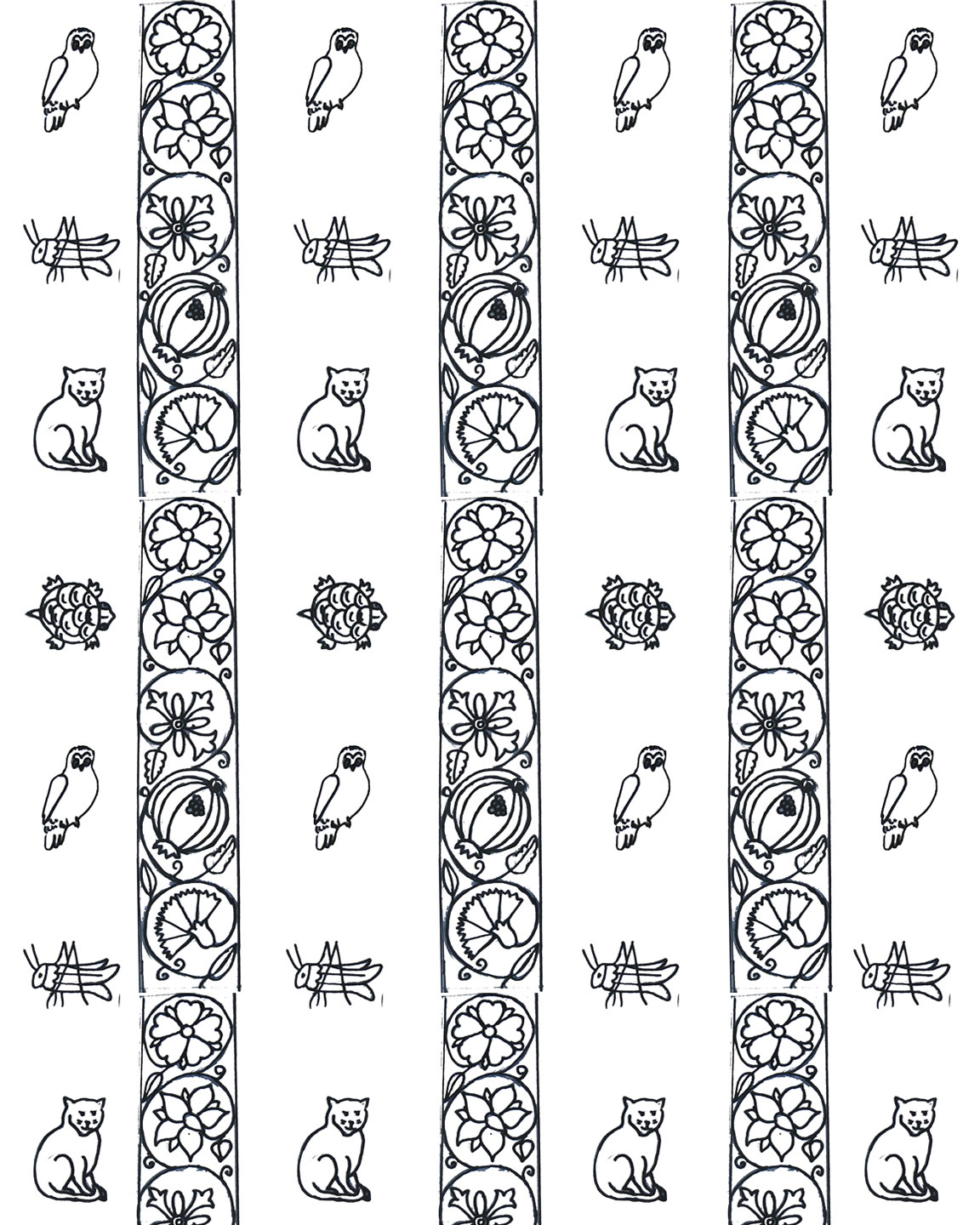
So, I was looking at my freshly inked sleeved, and showed the design to my husband. I said, "I think there's too much white space in between the animals." And then I went back and looked at the original. And sure enough there are 5 animal motifs. On the TORSO. There are SEVEN on each arm. So, back into illustrator, and now to re-ink a new sleeve. The husband is seeing if oxyclean can get the ink off of the already hemmed and corded inked sleeve, but if not...new sleeve it is!
However, it could be much, much worse. I hadn't started any embroidery yet, and really, since I figured out doing it in Adobe Illustrator, it's much easier to revise and print my new design.
But I hate, hate, hate to waste things, especially fabric. I might be able to use the floral bands for the cuffs and collar, perhaps, and that might make me feel better. So we'll see.
Sleeve Design

When I transfer the design, I won't use the existing lines along the flowers- I'll transfer the center curvalinear design, and then do the lines with rulers, so they're all even. :)
The shirts and smocks that are my inspiration pieces are slightly late for me, being 1590s-1610s, instead of my preferred period of 1570s, but there is at least one painting of a woman in a fitted loose gown with embroidered smock sleeves underneath. However, that design is a geometric latticework, not a mix of isolated motifs and floral bands.