Tuesday, March 24, 2015

Nightcap is finished!

Better pics when I get the chance, but here is a finished shot!

Monday, January 13, 2014

Nightcap design

I tend to break 16th century English monochrome designs into 5 basic "families". The most commonly recognized are:

*The curving vines;

*Bands, often containing the curving vines, often on shifts and shirts;

*"Lozenge" patterns, in which the motifs are set into rhombus/diamond shaped areas (and in at least one example, hexagonal);

*"Diaper" repeating patterns- one or two motifs repeated at regular intervals throughout the entirety of the piece;

*"Free" embroidery- assorted monochrome motifs, placed both regularly and sporadically throughout the piece. (This is seen once we move into the 17th century pieces- it may be transitional from Elizabethan monochrome towards the later crewel work).

The nightcap is the second piece I am making towards attempting to achieve an "Expert" ranking in the East Kingdom's Embroiderers Guild, the Keepers of Athena's Thimble. Along with the shift, I'm doing a man's nightcap, and I plan to do a coif with a diapered pattern. These three items will represent 3 of the major families of English monochrome.

For this nightcap, I wanted to use some of my old favorites, but also play with some designs I haven't used before. I also attempted to make slightly more "masculine" motifs- the husband requested "no butterflies" (although we DO see them regularly on the extant nightcaps.)

I used borage, roses, peas, pomegranates, and honeysuckles again. I added more leaves, pears, and grapes. I used more birds; I included bugs of all kinds; and I incorporated a frog, squirrels, turtle, cat, and an elephant. The turtle, cat, elephant, and frog were taken from textile T.88-1925 at the V&A Museum. This wonderful piece is a bunch of assorted animals inked onto linen, thought to be for embroidery. I was so happy to use the elephant- while struggling to fill one void of space, I asked what animal he would like on it. The squirrels were taken from a man's nightcap at the Manchester City Galleries- nightcap 1959.271. It's hard to see online- the black silk animals have disintegrated, leaving only the outlines behind. I was fortunate to spend time in the study rooms this summer, and have many up close pictures where the outlines are visible.

I will be transferring the design tomorrow, using a lightbox. Although I did get a pounce kit, I may use that on the cuffs of the shift. It seems to be a more time-consuming method, since it involves multiple steps- first pricking, then pouncing, then inking. So the lightbox transfer allows me the most "can't wait to get started" gratification. This project is serving as a break from the shift, which although lovely, is rather repetitive in a large space.

I will be working the motifs in a black silk stem stitch, and possibly trying actual teeny-tiny speckling as filler. I will be checking in with the extant pieces for reference photos. I want to do the stem in plaited braid in a gilt passing thread, and the husband has already been asking about spangles. (I should have put a peacock in the design!)

Wow, been a long time...

My apologies for being so neglectful! I moved in August, and am working a new position at my school, so embroidery has been on the back burner.

Both sleeves are now done on the shift- so only the torso and cuffs and collar to go!

I also am in the process of inking the design for my husbands nightcap- Pics this evening, with more info on the design and motifs, plus plans for embroidering.

Tuesday, August 6, 2013

Pennsic Wrap -Up In Brief

I taught at Pennsic. :D

The following page will take one to the class notes I handed out:16th Century English Monochrome Embroidery.

This document also contains the appendices of all of the extant 16th century English monochromatic embroidered pieces I've found. A quick-and-dirty analysis of the data reveals roughly 80% of the pieces are uncounted, versus 20% possibly counted. More information on my observations is found in the class notes.

I hope this challenges the way we've been thinking about "blackwork". Please feel free to contact me with any questions or suggestions! I welcome all correspondence on this topic. :)

Monday, July 15, 2013

Review from England

I was fortunate enough to take a 10-day trip to England two weeks ago. I had made study appointments at Platt Hall/Gallery of Costume in Manchester, and the Museum of London. I had stopped working on my shift for a bit- I was secretly very nervous that after getting up close and personal with so many extant pieces that I would be doing is "wrong".

My trip was wonderful. I got amazing pictures, and everyone I worked with was very helpful and knowledgeable. And the trip confirmed a lot of what I was already suspecting, which of course makes me paranoid about confirmation bias. ;) Some details: every piece I looked at was of English provenance, late 16th to early 17th centuries. There were no reversible pieces- even pieces, such as forehead cloth 2003.65 from Platt Hall, which is blackwork and cutwork, was NOT reversible, even though it really looked like it could be. All of the collars were lined, so even if they are reversible, we can't tell.

To the best of my knowledge, there are no double-running reversible pieces currently existing of English provenance. Which, if one thinks about it, just makes sense. Why would people be making reversible pieces, if no one is ever going to see the back?

"But Amy", I hear you asking, "Portraits of Jane Seymour and Catherine Howard by Hans Holbein show geometric ruffles on the ends of her sleeves; surely they would be reversible, because one could see the other side?" And yes, those paintings exist. And looking at them, it's hard to say for certainty if those are actually reversible- they look like they could be. There's few extant English pieces with wrist ruffles- I'd love to examine boy's shirt T.112-1972 at the V&A- it does have embroidered wrist ruffles, although I haven't seen the undersides. Smock T.113 to 118-1997 does seem to have both sides of the ruffle the same- however, since there's use of detached buttonhole on both sides, does that actually count as "reversible embroidery" the way we suggest? What does "reversible" actually mean in embroidery? Does a neat underside count? Or do both sides have to be absolutely identical, with one the clear, precise, reverse of the other?

So my current thinking is that I could produce an shirt for use with a 1540s ensemble with an embroidered collar and embroidered reversible ruffles, and I may be able to defend that. I would be a little weak on evidence, having only a few pieces, and most of those paintings, to defend it. If I produce the same thing and wear it with a 1580s ensemble, then I'm getting WAY off track- by this time, English monochrome embroidery is very much evolving away from the earlier styles.

As always, my object is always to challenge preconceived ideas of thinking. Look for yourself, and draw your own evidence-based conclusions. Come see me at Pennsic, and argue with me about what you found. I'll happily incorporate new pieces into my own schema, provided they are a. English provenance, and b. dated 1500-1625. Have fun!

Tuesday, May 14, 2013

Constructs and Blackwork

So I’ve been thinking about “blackwork” a lot. This has been influenced by my research for an Expert panel for Athena’s Thimble, but also by some recent discussions on facebook. I repeated my assertion that counted reversible blackwork is really not the norm for 16th century English monochrome embroidery, and definitely ruffled some feathers. And I understand why- as a constructivist, I understand that knowledge is based on constructs, and it’s upsetting when constructs are challenged.

In brief, a construct is a belief that is built and developed over time. As adults, our constructs tend to be very firmly built and solid- children have slightly more fluid constructs especially during the 0-5 years. Constructs include an emotional component, and people react violently in some cases when a construct is challenged. This is why you can teach a child that a cat is not a dog, even though both are furry and have four legs, but try to convince an adult that “blackwork in England is mostly not counted or reversible” and you will have a fight on your hands. And I understand. My very first pieces of blackwork were a charted counted reversible cuffs and collar. It was only when I really began LOOKING at what was there that I began to think maybe I wasn’t seeing the whole picture. And that took years of looking.

People respond with exceptions, citing the portrait of Jane Seymour with geometric counted cuffs. Which is a valid example. However, where do we draw the line? If we can say, well, rough 70% of the paintings during this given time and this given place, and 85% of the extant items show these characteristics, then, to me, those would indicate something “true” about embroidery in that specific time and space. And I think we need to recognize that time and space are CRUCIAL- just because we have examples of a low-neck gathered camisa in Italy in the 16th century doesn’t mean that English smocks in the 16th century were made in the same way. Embroidery, likewise, is not necessarily universal in style and technique. We can say with some certainty: This is most common of the pieces and paintings we have. There are always exceptions, and those rare anomalous examples. We have an incomplete record, so we may have to change our constructs in the face of new evidence. If someone unearths a treasure trove of counted reversible cuffs and collars, I will rework my hypotheses. But we have to make our assertions based on the evidence at hand- not we “want” to be true. And this means understanding ‘the common’.

If I’m judging A& or taking a class then I’m looking for an understanding of what we can prove are the dominating trends and characteristics, and NOT someone cherry-picking examples and pieces- that, to me, shows a lack of understanding about the art form as a whole, for a given time and space. But this also assumes everyone thinks like me- I strive to be a historian first, and an artisan second. As a historian, I have rules and confines which govern me- the historical record that exists is my teacher. I must make my decisions based on the reality of that record.

Monday, March 25, 2013

So that happened.

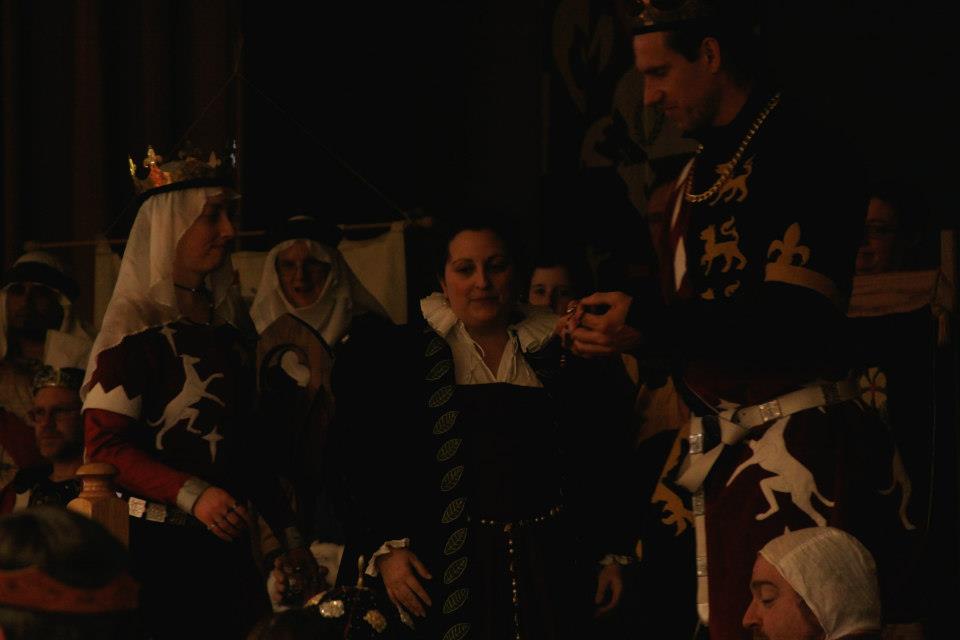
On Saturday, at Mudthaw, Their Majesties of the East, Edward and Thyra, offered me elevation to the Order of the Laurel. After much contemplation and counsel, I accepted. So I am now technically Mistress Amy Webbe, of the East. :) Here's a pic...I'll post more as I get them.

Thursday, March 14, 2013

Projecte Update

Here as a progress shot of the blackwork shift- one and a half sleeves finished. I really love the look of the "free" blackwork. Which leads me to my next thought: I'm finding very, very few actual examples of counted English blackwork. We absolutely have counted monochrome embroidery from other parts of the world; however, if we work with the definition that blackwork is "16th century English monochrome embroidery", then, by it's very provenance, extant pieces of 16th century Italian monochrome cannot be examples of blackwork. More on this to come.

Sunday, December 2, 2012

On mastery- more questions than answers...

In response to my post about "thinking", someone made the comment about obtaining mastery "if that's what one wants to do". Which got me thinking about what exactly mastery is. What does it mean to be a master?

It occurs to me that we can point to some forms of mastery. We can look at an athlete, a musician, a fine artist, a dancer, and say that they produced something flawless. But can we say that about a novel? A dissertation? A composition? A theorem? It seems the products of our hands are far more likely to be objectively considered perfect than the products of our minds.

So what does it mean, then, to obtain "mastery"? Is it the act of producing a flawless object, or is it the journey required to produce that object? Can one be separated from the other?

And when does one become a "Master"? Is it a title one assumes on one's self? Is it a title one accepts from one's peers? Or from one's students? Or does true Mastery come when one accepts that one knows nothing? (Or perhaps one should not write blog posts when watching "Kung Fu Panda".)

Is Mastery even something one can seek? Or does the very act of seeking it nullify it?

What do you think?

Interlude- Drawnwork and Needlelace

The shift is very slow going. I'm possibly intimidated by the scope of the project, or possibly the actual size of the panels that need to be embroidered. The motifs themselves move quickly- 40 minutes or so. So I should be much further along, but I'm trying not to feel too guilty about it.

It occurred to me that perhaps I needed to do something smaller for a break, so I could finish something and feel like I accomplished things. I have a tendency to choose huge projects requiring hundreds of hours, so I needed to do something smaller.

I was considering the categories for Athena's Thimble, and realized I still had no ranking in 4 of them- drawn/open work, lacis, needlelace, and padded work. I had started working on a raised-work bee at Pennsic, and I may go back to that. But I decided to give drawn thread work a try.

I began by taking a piece of 3.5 ounce linen (approx. 80 threads per square inch) and remove 6 threads together. This may have been slightly more than I wanted, but I wanted it to be visible. I did a hem stitch to create a half-inch hem, and then went back and worked the drawn threads in both directions, creating, in theory, little boxes. Somehow, I got a torque in the material, so my lines slant- this may be a result of tension, hemming, or of removing too many threads. I should experiment in the future. I then decided to add a simple needlelace border, using 40/2 linen thread. Ideally, I would like to use 60/2, or perhaps 90/2, but I couldn't find those in my stash. the 120/2 was simply too lightweight too work. Overall, I'm happy with how my border came out, but it is a little "thick", probably due to the thread weight. The border was worked by making bars and covering with a buttonhole stitch.

Sunday, October 7, 2012

Blackwork Shift- Progress Shot!

Here is a pic of almost half of one sleeve completed:

It moves much faster than the polychrome embroidery, averaging about 40 minutes or so a motif. I'm still struggling with stem vs. outline stitch, and sometimes the stitch just looks "rope-y" no matter what I do, but that is in keeping with extant pieces, so the overall effect is still Elizabethan, at least to my eyes.

I rather enjoy how each little critter has their own personality.

Tuesday, September 4, 2012

Thinking about Thinking

Today was the first day of school for teachers in my district. (I'm a teacher-librarian.) Like most in-services, this one touched on more effective teaching methods, and cited Bloom's Taxonomy. Bloom's Taxonomy is an organization of "higher order thinking skills" going from basic memory and recall at the bottom, to creation or evaluation at the top (evaluation is the traditional top, creation is at the top of the revised taxonomy). Here's a graphic from Miami of Ohio Office of Community Engagement:

It occurred to me that this also applied to the construction of deep knowledge in the SCA, particularly in applied Arts and Sciences. Let's use embroidery as a "for instance". When we begin looking at embroidery, we may begin by learning about the extant pieces. We can name them, locate them, and maybe find new ones. We are at the stage of "knowledge". We may then begin examining them more closely- maybe we identify the stitches being used, and maybe we figure out how the object was made. We may share this knowledge with others, demonstrating our "comprehension" of the subject. When we actually make a replica of an object, we've moved up to "application" of our comprehension. We don't just own the information, we've used the knowledge to construct something similar. Now this is where it gets tricky. What, exactly, is the difference between "application" and "creation/synthesis"? Well, it really depends on the next step, "analysis". Without a thorough analysis of the subject as a whole, one cannot truly synthesize their knowledge. Without an understanding of time and place, motifs, themes, and styles, one is left only applying their knowledge, instead of synthesizing it into a new creation.

At the top of the pyramid is synthesis and evaluation. These two really do go hand in hand. Without a critical eye (and I mean constructively critical) one cannot truly create a period artifact. One needs to evaluate what is (and is not!) there in the object before one can make informed choices about the object one is about to create.

So, in slightly simpler terms, using embroidery as a metaphor:

Knowledge: There is a polychrome coif in the Met, acquistion number 64.101.1258.

Comprehension: It's worked in detached buttonhole and plaited braid stitches.Motifs are birds, butterflies, roses, lillies, cornflowers.

Application: Experimenting shows that outlining the flowers first in stem stitch makes it easier to do the detached buttonhole evenly. Starting with a row of running stitches stops me from making too many buttonhole stitches.

Analysis: These flowers are all found in an English kitchen garden; many others also use blue borages; the plaited braid is done using gilt thread on the extant examples, whether coif, nightcap, or jacket.

Synthesis and Evaluation: A new design is created, using the most commonly found examples from extant pieces. The designer can explain every decision, without having to cite rare or out-of-period examples. The designer can also note where he or she may have deviated from the extant pieces, and discuss why.

These stages do overlap each other, and constructing deep knowledge is a never-ending process. We always begin with some sort of memory/recall/knowledge of the subject, and tease out comprehension as we apply. But it's in the synthesis and evaluation that one can really begin to achieve some mastery over the subject.

So what do you think about this? Does Bloom's Taxonomy apply to you and your field? How? Should it apply in the SCA? How?

Sunday, August 26, 2012

Moving along...

My classes yesterday seemed to go very well. My polychrome class is down pretty solid- it helped to have done it twice at Pennsic. My monochrome class was a little bit rougher, but I think I communicated successfully what I wanted to, which is that that is a whole world of uncounted blackwork out there that should be explored, especially for the Elizabethan time period.

Moving ahead, I think I'm going to be working on two more classes: The first will be "Elizabethan Embroidery Emblems Explained". While driving to the site yesterday, I was reflecting on how the contextual Elizabethan understanding of motifs is missing from my knowledge- I know that these motifs meant something to their audience, in part due to their shared socialization, but I don't know what that is. For example, we (mostly) understand what "he's an ant, I'm a grasshopper" means. So using an image of an ant or a grasshopper would have meaning for ourselves and our audience. The Elizabethans had a similar and similarly complex language of symbols and metaphors, and I need to research that, and assimilate it into my schema, as best I can. (I'm suddenly reminded of a Star Trek episode and a culture that only dealt in metaphors.) This will absolutely help my understanding of the embroidery in it's time and place in history.

The other class I'm considering is "How to Share Your Joy: Tips for Teaching an SCA audience". My husband and I were discussing some of the classes we took at East Kingdom University yesterday. And he remarked that I should consider teaching a class for teachers- I'm an educator by trade, having done informal museum education while an undergrad, and then teaching formally in public schools over the past decade. My recent graduate school experience has trained me to be a facilitator for adult educators- a "teacher of teachers". So I think that class may be worthwhile as well. It's not an attempt to criticize- we have many, many knowledgeable people in the SCA. But not everyone is trained to think about HOW they are communicating and interpreting for their audience. Something as simple as "Know what your objective is. Know what you want students to understand when they walk out the door", could really help people create strong lessons that leave everyone with a positive feeling about the interaction.

Wednesday, August 15, 2012

Reflections

I taught a class on Late 16th/Early 17th C. English Polychrome embroidery. Here are the class notes: Polychrome Class Notes.

I feel like the class went very well- my goal to was to "root" polychrome embroidery in it's historical time and place, as well as to communicate what I see when I look at the embroidery.

Too often, I think that when "mistakes" are made, it's a matter of interpretation. The scale is off from the historical examples, the colors or use of white space are off, and this is something I tried to communicate. And it's also something I only truly understood after thousands of hours of looking at the same pictures, revisiting them again and again.

It's such a tricky thing. Because each extant piece was made by a person, there are bound to be variations. Nothing is true all the time, and we can always find exceptions and anomalies. What I try to communicate is what I see to be the most common- what I see again and again when I view extant examples. Sure, anyone can find the one random example, but I prefer to go with the things I see consistently, and can document to more than one item. It just feels more "right" to do that. It doesn't mean, however, that I know everything. I frequently feel a sense of panic over just how much I don't know. I learn new things all the time, and one of the reasons I love teaching is because I have the opportunity to learn from my students. I'm sharing what I see- but each person brings their own eye to it, so what I see may be different from what you see, and that's awesome. :)

I'm teaching this class again at East Kingdom University on 8/25, and I'm also teaching a class on 16th C. English Monochrome Embroidery. This one makes me a bit more nervous- I'm trying to do an overview of a century of a style of embroidery, and a style that I believe to be often misinterpreted. I may take on the sacred cow of counted reversible blackwork, and it will be interesting on a couple of levels. #1 is that is may not be as sacred a cow as I think it is, and #2, it's possible that my own confirmation bias may be playing into it. That's one of the most challenging things, I think. Am I honestly seeing what I think I'm seeing, or am I merely finding examples that confirm what I expect to find? I don't think it's confirmation bias, because I developed my theories from observation of the extant pieces, instead of looking for extant pieces to fit my theory. But it's still important to be mindful of the dangers.

I hope you've enjoyed this little glimpse into my thought process. :D Here's a progress pic from my shift:

Sunday, July 22, 2012

Upcoming classes

I will be teaching at Pennsic XLI:

Late 16th Century English Polychrome Embroidery: This class will cover the historical context of late 16th century English polychrome embroidery. We will discuss materials, techniques, and meaning of this embellished, exquisite domestic art form. We will view many historical examples, including coifs, jackets and nightcaps. This class is a lecture/dicussion only.

I will also be teaching at EKU (East Kingdom University) on August 25th, in Bhakail:

Late 16th Century English Polychrome Embroidery: This class will cover the historical context of late 16th century English polychrome embroidery. We will discuss materials, techniques, and meaning of this embellished, exquisite domestic art form. We will view many historical examples, including coifs, jackets and nightcaps. This class is a lecture/dicussion only.

and

16th Century English Monochrome Embroidery: This class will cover the historical context of monochrome embroidery (colloquially called "blackwork") in 16th England. We will discuss materials, techniques, and design of this art form. This class is a lecture/discussion only.

I'm focusing on the historical context of both of these embroidery forms, in attempt to "train the eye" of my students. I find that there are a lot of videos that demonstrate techniques, and there are also a lot of classes that focus on the "how" instead of the "why" of embroidery. I really love the "why", and want to share that understanding. For instance, we often teach blackwork as a reversible, linear, counted form. But when we really examine the extant pieces, and the paintings, that sort of blackwork is a very small percentage, early in the century. The vast majority of monochrome embroidery, both extant and in portraits, is uncounted, often curvalinear, sometimes naturalistic, speckled, filled, representations of actual objects, such as plants, animals, and flowers. The reversible linear, counted blackwork is such a small part of monochrome embroidery, I'm really beginning to wonder why it is so often the focus of classes. But, I'm on my soapbox again. Please feel free to add any dissenting input in the comments. ;)

My class notes will be available on my wikispaces, as soon as I get them finalized.

Thursday, July 19, 2012

Progress shot

I had to rip out quite a bit, since my stem stitch was being difficult. Too many "feet". So I texted Mistreess Cellcah, who suggested "smaller stitches, and try coming to the other side (i.e. work the stitch from left to right, instead of right to left, for example)." I did those things, and have had more success. I'm still a little concerned that parts are looking "hairy" but the thread (soie perlee) seems very tightly wound, more so than when I used soie perlee with my polychrome coif. So I'm not sure if it's a materials thing, or a user error. Probably a user error. ;) But it gets better as I go on, and the overall effect is very pleasing. I'm waiting until the sleeve is off the frame to do the lines along each floral band, so I can make sure they are embroidered straight, instead of torquing because of being stitched to a frame.

Sunday, July 15, 2012

Woops!

So, I was looking at my freshly inked sleeved, and showed the design to my husband. I said, "I think there's too much white space in between the animals." And then I went back and looked at the original. And sure enough there are 5 animal motifs. On the TORSO. There are SEVEN on each arm. So, back into illustrator, and now to re-ink a new sleeve. The husband is seeing if oxyclean can get the ink off of the already hemmed and corded inked sleeve, but if not...new sleeve it is!

However, it could be much, much worse. I hadn't started any embroidery yet, and really, since I figured out doing it in Adobe Illustrator, it's much easier to revise and print my new design.

But I hate, hate, hate to waste things, especially fabric. I might be able to use the floral bands for the cuffs and collar, perhaps, and that might make me feel better. So we'll see.
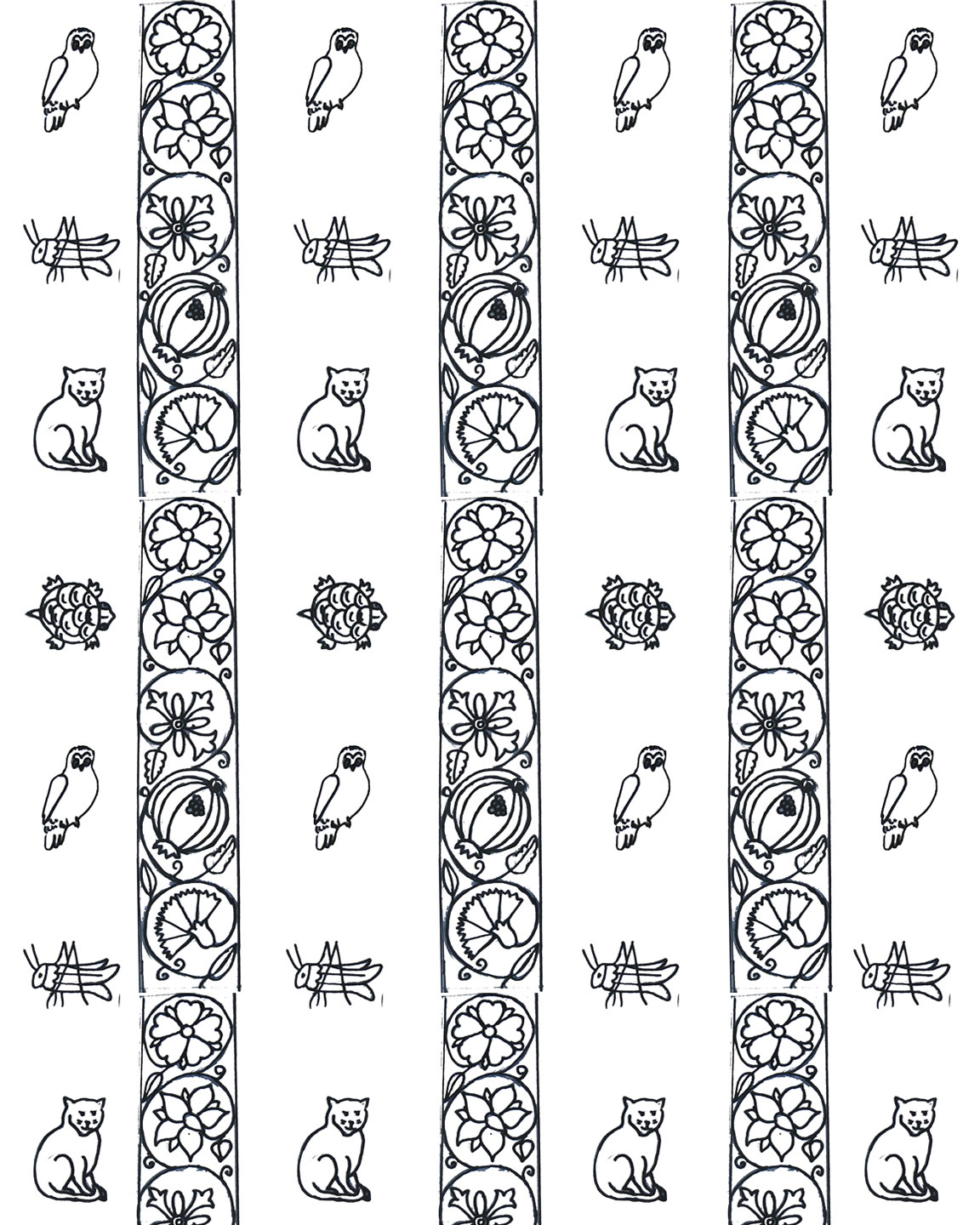
Sleeve Design

When I transfer the design, I won't use the existing lines along the flowers- I'll transfer the center curvalinear design, and then do the lines with rulers, so they're all even. :)

The shirts and smocks that are my inspiration pieces are slightly late for me, being 1590s-1610s, instead of my preferred period of 1570s, but there is at least one painting of a woman in a fitted loose gown with embroidered smock sleeves underneath. However, that design is a geometric latticework, not a mix of isolated motifs and floral bands.

Monday, June 25, 2012

Elizabethan Embroidery Bibliography

I have compiled a list of the resources (books, websites, and journal articles) that I have used as resources for my documentation. This list is not meant to be completely exhaustive of all late 16th/early 17th century English embroidery, and does focus more on embroidery of clothing accessories, as opposed to home textiles.

Elizabethan Embroidery Bibliography

Wednesday, May 23, 2012

Revised Design

I substituted a pomegranate for the strawberry. The strawberry wasn't visually interesting enough, and I haven't used a pomegranate before. Plus, pomegranates come up frequently in monochrome embroidery, and strawberries do not, although they are often seen in polychrome embroidery. Plus, I moved the grasshopper's rear end. :)